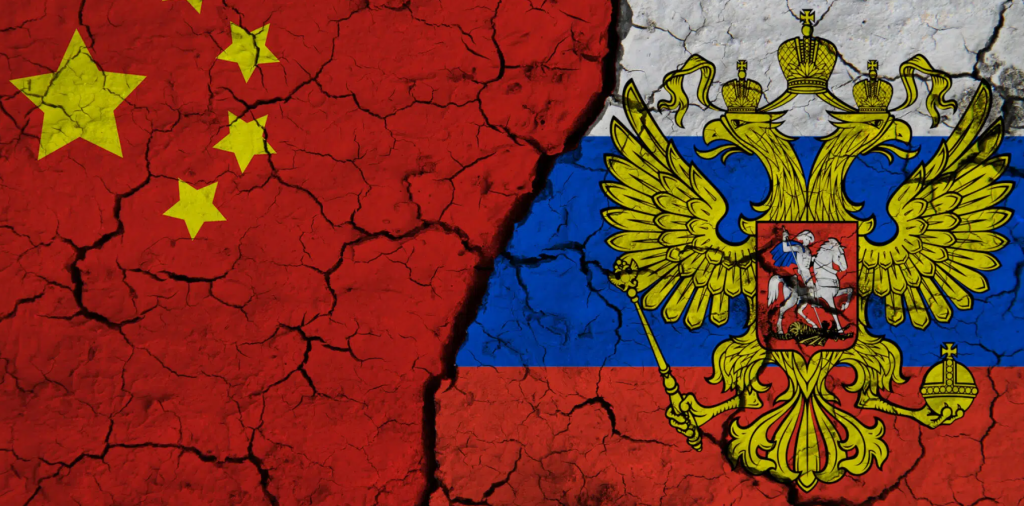
“Russia thought they had $600 billion of foreign reserves. And now they don’t,” observes capital markets strategist Byron Gilliam. “Their central bank has been rugged.”
That’s because no matter how big a number that is – in this case, it’s roughly the size of the entire economy of Norway – it’s all worthless unless you can spend it. Very little of this is held in physical notes. If that were the case, then no matter what the rest of the world thinks of Russia’s aggression in Ukraine, Vladimir Putin and his oligarchs could spend it all however they saw fit. Bills with no identifiable information – aside from basically untraceable serial numbers – are totally fungible. But figures on the spreadsheet of another sovereign nation’s central bank – which is the reality of all these foreign reserves – can be tracked, frozen or even expropriated.
Gilliam’s excellent article for the Blockworks newsletter predicts that China will be the next country to see centralized banking weaponized against it.
“Should [the Chinese] assert their authority over Taiwan, say, they now know that the cost will include the loss of $1 trillion of digital IOUs (aka, Treasurys),” according to Gilliam. “Is there any doubt they would decentralize those assets if they could? If there were an algorithmic stablecoin that could absorb trillions of dollars of demand, China would be all-in.”
Thought experiment
He then goes into some out-there-where-the-buses-don-t-run theorizing about how such western, liberal democracies as Switzerland, Norway and the United States could start using their centralized banks, clearing houses and sovereign wealth funds as economic cudgels against each other.
“This is mostly a thought experiment, of course,” he clarifies. “Crypto markets will not be liquid enough to absorb the assets of a central bank much larger than El Salvador’s anytime soon.”
Still, his point is taken. India, Saudi Arabia and South Korea each have almost as much forex in their electronic wallets as Russia does. China, Japan, Switzerland and the Euro zone hold more than $1 trillion each. The U.S. is somewhere in between; it would be higher, no doubt, if the greenback weren’t the world’s leading reserve currency. That’s a lot of IOUs that could be cashed in as a result of public policy. That policy might be based on good intentions as well as bad ones – climate protection as well as a war of conquest – but it would have the same effect on the fortunes of the targeted nation.
We’re left to wonder: If, as we cryptocurrency enthusiasts would have it, money were decentralized, could this world become a more peaceful place?
The wrap
When the dust settles in Ukraine – and we all hope for a swift, honorable and equitable end to hostilities – the headlines will probably scream about how artillery- and armor-based warfare are still possible even in prosperous, post-industrial Europe. The next day, the news feeds will discuss the role that cyber-attacks played in the conflict. But will we ever see a story about how finance was weaponized?
Probably not, because it’s hard to imagine John Cena or Dwayne Johnson playing a central bank chairman. And yet we are seeing in real time how centralized assets are contributing to global risk.
At USDC, we also see the corollary: that decentralized assets could remove that risk. To its use cases as a store of value and medium of exchange, you can add de-escalation to the list of cryptocurrency use cases.
Just as anti-nuclear activists from the 1980s weren’t advocating for Soviet hegemony, we’re not arguing for Russian hegemony. We just want to see money demilitarized.